The Diaphragm Muscle
Key Takeaways:
The diaphragm muscle plays a central role in breathing as well as stabilizing the trunk, contributing to efficient posture and movement, and triggering our relaxation response.
If you have poor use of your diaphragm you may experience less efficient breathing, rib and chest discomfort with movement*, impaired core coordination, and pelvic floor dysfunction**.
Diaphragm muscle control is about coordination, not force. Daily practice will make a significant impact on efficient control.
*Pain around the ribs can also have many different causes. Diaphragmatic breathing exercises may help some people reduce unnecessary muscular tension, but new, significant, or persistent chest or rib pain deserves appropriate medical evaluation.
**Diaphragmatic breathing alone will treat pelvic floor dysfunction. Pelvic health problems can involve muscles that are weak, overactive, poorly coordinated, or affected by other factors which should be evaluated by a pelvic health specialist.
When we think about the muscles that help us move, we often think about our arms, legs, or abdominal muscles. But one of the most important muscles in the body is one we rarely think about: the diaphragm.
The diaphragm plays a central role in breathing, but its job goes far beyond simply moving air in and out of the lungs. It also works with the abdominal and pelvic floor muscles to help stabilize the trunk, contributes to efficient posture and movement, and is closely connected to our body’s relaxation response.
Learning how to use the diaphragm effectively can be a valuable tool for athletes, active adults, and anyone looking to improve breathing mechanics, manage stress, or develop better core control.
What Is the Diaphragm?
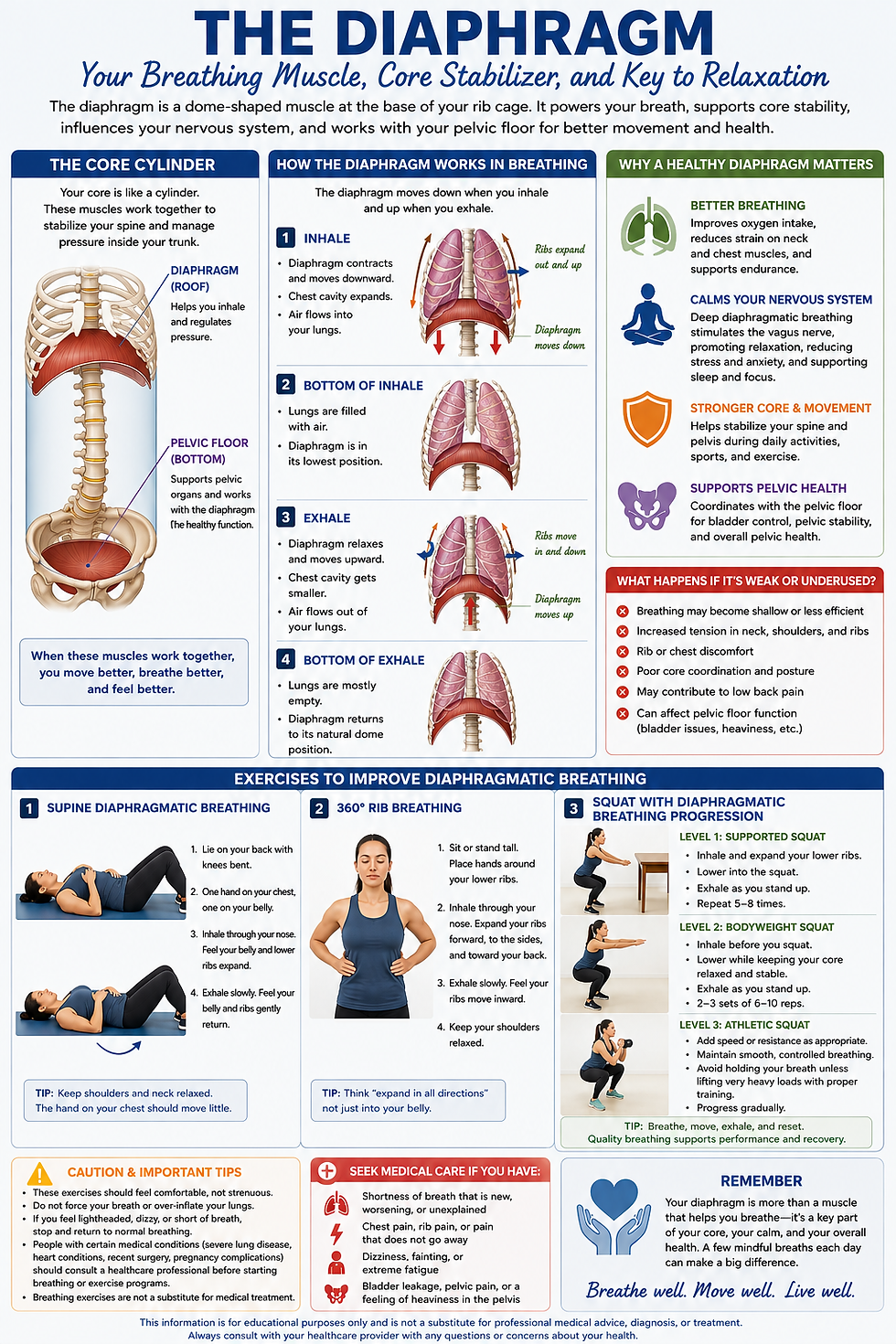
The diaphragm is a large, dome-shaped muscle located at the bottom of the rib cage. It separates the chest cavity, which contains the heart and lungs, from the abdominal cavity, which contains many of the digestive organs.
The diaphragm attaches around the lower ribs and connects to structures along the spine. Because of its shape and location, it essentially forms the “floor” of the rib cage and the top of the abdominal cavity.
Its primary job: breathing
When you inhale, the diaphragm contracts and moves downward, creating more space inside the chest. This allows the lungs to expand and draw air inward.
When you exhale, the diaphragm relaxes and moves upward as the lungs and surrounding tissues recoil, helping push air out.
This process happens automatically thousands of times every day.
But the diaphragm isn’t just a breathing muscle.
The Diaphragm and Your Nervous System
Breathing is closely connected to the autonomic nervous system — the system that helps regulate functions such as heart rate, blood pressure, digestion, and the body’s response to stress.
Slow, controlled diaphragmatic breathing can encourage a shift toward the parasympathetic nervous system, often described as the body’s “rest and digest” state.
One pathway involved in this process is the vagus nerve, an important nerve connecting the brain with organs throughout the body, including the heart, lungs, and digestive system.
Slow breathing, particularly when it emphasizes a comfortable and controlled exhalation, has been associated with changes in heart-rate variability and autonomic activity. These effects are one reason controlled breathing is commonly incorporated into practices such as meditation, yoga, mindfulness, and relaxation exercises.
Breathing as a stress-management tool
When we’re stressed, our breathing pattern can change. We may begin breathing more quickly, taking smaller breaths, or using the muscles around the neck and upper chest more than usual.
This can create a cycle:
Stress → altered breathing → increased physical tension → more awareness of stress
Intentional, slow breathing can help interrupt that cycle.
This doesn’t mean diaphragmatic breathing “cures” anxiety or that everyone will experience the same response. Rather, it provides a simple way to practice regulating breathing and creating a calmer physiological state.
For children and adults alike, learning to slow the breath can be a useful component of a broader stress-management strategy.
The Diaphragm Is Also Part of Your Core
Many people think of the “core” as simply the abdominal muscles. In reality, core stability involves a coordinated group of muscles that surround the trunk.
Think of the core as a cylinder:
Diaphragm: the roof
Abdominal muscles: the front and sides
Spinal muscles: the back
Pelvic floor muscles: the bottom
The diaphragm works together with these muscles to help regulate pressure within the abdominal cavity and stabilize the spine.
Every time you breathe, your diaphragm is participating in this system.
When you lift, run, jump, change direction, or balance on one leg, your body needs to coordinate breathing with trunk stabilization. Efficient diaphragm function can therefore contribute to efficient movement.
This is particularly important for athletes, but it also matters during everyday activities such as lifting a child, carrying groceries, climbing stairs, or getting up from a chair.
What Happens When the Diaphragm Is Weak or Underused?
The diaphragm doesn’t necessarily become “weak” simply because someone doesn’t consciously think about using it — breathing is automatic. However, certain conditions, prolonged inactivity, respiratory problems, pain, altered posture, or habitual upper-chest breathing can affect how effectively the diaphragm contributes to breathing.
When diaphragm function is impaired, several things can happen.
1. Breathing can become less efficient
If the diaphragm isn’t contributing effectively, the body may rely more heavily on accessory breathing muscles around the neck, shoulders, and upper chest.
This can result in a breathing pattern that feels more shallow or effortful.
For someone participating in exercise or sports, inefficient breathing mechanics can make it more difficult to coordinate breathing with movement and may contribute to early fatigue or a sensation of breathlessness.
Importantly, breathing difficulties can have many causes, so persistent shortness of breath should be evaluated by a healthcare professional rather than assumed to be a diaphragm problem.
2. Rib and chest discomfort may develop
The muscles surrounding the ribs are also involved in breathing. If someone consistently breathes with excessive upper-chest movement or holds tension through the rib cage, the muscles and joints around the ribs can become irritated or uncomfortable.
Pain around the ribs can also have many different causes. Diaphragmatic breathing exercises may help some people reduce unnecessary muscular tension, but new, significant, or persistent chest or rib pain deserves appropriate medical evaluation.
3. Core coordination may be affected
Because the diaphragm participates in managing pressure inside the trunk, changes in breathing can influence how the abdominal and pelvic floor muscles coordinate during movement.
Someone who consistently holds their breath or braces their abdomen excessively may have difficulty coordinating breathing with movement.
The goal isn’t to keep the abdominal muscles constantly tight. Instead, we want the diaphragm, abdominal wall, spinal muscles, and pelvic floor to work together and adapt to the demands of the activity.
4. Pelvic floor function can be influenced
The diaphragm and pelvic floor move in a coordinated manner during normal breathing.
During a relaxed inhalation, the diaphragm descends and the pelvic floor can lengthen slightly. During exhalation, the diaphragm rises and the pelvic floor can recoil upward.
This doesn’t mean that diaphragmatic breathing alone will treat pelvic floor dysfunction. Pelvic health problems can involve muscles that are weak, overactive, poorly coordinated, or affected by other factors.
However, learning to breathe without excessive abdominal or pelvic tension can be an important component of improving overall trunk and pelvic floor coordination.
Three Exercises to Practice Diaphragmatic Breathing
The goal of these exercises isn’t to force the belly outward as much as possible. Instead, focus on allowing the lower ribs and abdomen to expand comfortably in multiple directions while keeping the neck and shoulders relaxed.
Exercise 1: Supine Diaphragmatic Breathing

This is a great starting position because lying on your back allows your body to relax and makes it easier to feel the movement of your rib cage.
How to do it:
Lie comfortably on your back with your knees bent.
Place one hand over your upper chest and the other over your lower ribs or abdomen.
Relax your shoulders and jaw.
Slowly inhale through your nose.
Feel the lower ribs gently expand outward and the abdomen rise.
Slowly exhale without forcing the air out.
Allow the lower ribs and abdomen to gently return toward their starting position.
Repeat for 5–10 breaths.
Focus: Try to minimize unnecessary movement of the upper chest and shoulders.
Exercise 2: 360-Degree Rib Breathing
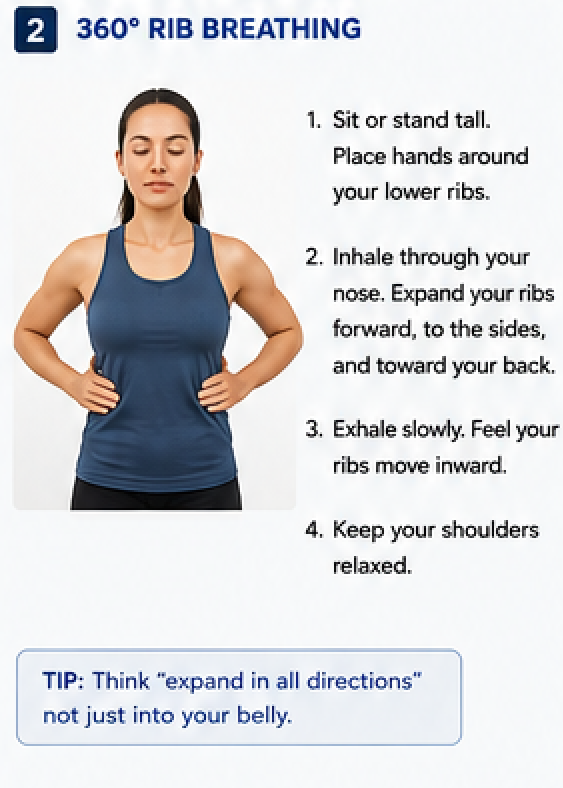
The diaphragm doesn’t only move the abdomen forward. Ideally, breathing creates expansion around the entire lower rib cage.
This exercise helps develop awareness of that three-dimensional movement.
How to do it:
Sit or stand comfortably.
Wrap your hands around the sides of your lower ribs.
Take a slow breath in through your nose.
Imagine expanding your ribs into your hands — forward, sideways, and toward your back.
Slowly exhale and feel the ribs settle inward.
Keep your shoulders relaxed throughout the exercise.
Repeat for 5–10 breaths.
Focus: Think “expand in all directions” rather than simply “breathe into the belly.”
This can be especially useful for athletes who need to coordinate breathing with trunk movement.
Exercise 3: Squat With Diaphragmatic Breathing — From Basic to Athletic

The ultimate goal is to take diaphragmatic breathing out of a quiet position and incorporate it into functional movement.
A squat is an excellent way to practice because it requires coordination between the legs, pelvis, trunk, and breathing muscles.
Level 1: Supported Squat + Breathing
Start with a comfortable squat using a wall, countertop, or stable support if needed.
Stand with your feet approximately hip- to shoulder-width apart.
Take a relaxed diaphragmatic breath, allowing your lower ribs and abdomen to expand.
Begin to lower into a squat while maintaining a relaxed, controlled breath.
Exhale as you return to standing.
Repeat for 5–8 repetitions.
Focus: Keep your shoulders relaxed and avoid holding your breath.
Level 2: Bodyweight Squat + Breathing
Once the breathing pattern feels natural:
Stand without using support.
Inhale comfortably before beginning the squat.
Lower into the squat while maintaining trunk control.
Begin a controlled exhalation as you drive through your feet to stand.
Reset with another relaxed breath before the next repetition.
Perform 2–3 sets of 6–10 repetitions.
Focus: Maintain a stable trunk without excessive abdominal bracing.
Level 3: Athletic Squat + Breathing
For an athlete, progress the exercise by increasing the movement demand while maintaining breathing control. This could include a faster bodyweight squat, squat-to-reach, or eventually a loaded squat when appropriate.
The emphasis remains the same:
Breathe → brace appropriately → move → exhale → reset
As resistance and intensity increase, athletes may naturally use breath-holding or bracing strategies for maximal-force efforts. The goal of this exercise is not to eliminate those strategies from every type of lifting, but to develop the ability to breathe and stabilize the trunk efficiently during submaximal movement.
If an athlete cannot maintain comfortable breathing while performing the movement, decrease the speed, resistance, or complexity until the breathing pattern becomes easier.
If you become lightheaded or uncomfortable, return to your normal breathing
Putting It All Together
The diaphragm is much more than a muscle that makes us breathe.
It is a central player in:
Breathing
Nervous system regulation
Core stability
Movement
Pelvic floor coordination
Developing awareness of diaphragmatic breathing can help us recognize unnecessary tension, improve breathing coordination, and practice shifting toward a more relaxed state.
For athletes, good diaphragm function can help coordinate breathing and trunk stability during movement. For people practicing yoga or meditation, controlled breathing can be an important part of relaxation and mindfulness. And for individuals working on core or pelvic floor coordination, learning to breathe without excessive bracing can provide an important foundation.
The key is coordination rather than force. We don’t need to consciously control every breath we take. Instead, practicing a few minutes of relaxed diaphragmatic breathing each day can help us become more aware of how breathing, posture, movement, and relaxation are connected.
And sometimes, the simplest exercise is simply to pause, relax your shoulders, and take a slow breath.
More Resources:
post contains affiliate links