The Gluteals: The Secret to Healthier Hips, Knees, and More Powerful Movement
Key Takeaways:
Glutes (including the maximus, medius, and minimus) are vital for athletes as a powerhouse and stabilizer, which means they are key for both performance and injury prevention.
Glutes become weak and over-lengthened with prolonged sitting.
Simple body weight exercises, when done regularly, can help reduce and prevent hip, knee, and back pain as well as improve athletic performance.

When most people think about the gluteal muscles, they think about aesthetics. As a pediatric physical therapist, I think about something much more important: movement, stability, injury prevention, and performance.
Whether your child is learning to walk, running across the soccer field, landing from a basketball rebound, or sprinting around the playground, the gluteal muscles play a critical role in keeping the body moving efficiently and safely.
Meet Your Glutes
The gluteal muscle group is made up of three muscles:
Gluteus maximus – the largest and most powerful muscle in the body
Gluteus medius – the primary stabilizer of the pelvis during single-leg activities
Gluteus minimus – a smaller muscle that assists with hip stabilization
While all three are important, the gluteus maximus and gluteus medius do most of the heavy lifting during everyday activities and sports.
What Does the Gluteus Maximus Do?
The gluteus maximus is the body’s powerhouse.
Its primary jobs include:
Extending the hip (moving your leg behind you)
Rotating the hip outward
Helping you stand up from a chair
Climbing stairs
Running faster
Jumping higher
Absorbing force when landing
Every sprint, jump, squat, and powerful push-off begins with the gluteus maximus.
What Does the Gluteus Medius Do?
The gluteus medius is often called the “unsung hero” of movement.
Its primary functions include:
Stabilizing the pelvis during walking and running
Preventing the hip from dropping when standing on one leg
Moving the leg out to the side (hip abduction)
Helping control the position of the knee during landing and cutting movements
Every step we take briefly places our entire body weight on one leg. Without a strong gluteus medius, the pelvis drops, the knee collapses inward, and the rest of the body has to compensate.
Why Are Strong Gluteals So Important for Healthier and more Powerful Movement?
Strong glutes don’t just make you more powerful—they make you more efficient and resilient.
During walking, running, hopping, jumping, and landing, the glutes help:
Keep the pelvis level
Maintain proper hip alignment
Prevent the knees from collapsing inward
Improve balance
Generate power
Absorb impact forces
Reduce unnecessary stress on joints and ligaments
Think of the glutes as the foundation of a house. If the foundation is unstable, everything built on top becomes less stable as well.
Glutes and Sports Performance
Nearly every sport relies on strong glutes.
Athletes use them to:
Sprint down the field
Jump for rebounds
Change direction quickly
Land safely
Accelerate explosively
Climb, skate, dance, tumble, and swim with power
Sports that especially depend on glute strength include:
Soccer
Basketball
Volleyball
Track and field
Dance
Gymnastics
Tennis
Football
Baseball and softball
Swimming
Lacrosse
Even endurance athletes depend on glute endurance to maintain proper form over long periods of activity.
What Happens When the Glutes Are Weak?
When the glutes aren’t doing their job, other muscles try to compensate.
This often leads to poor movement patterns and increased stress on the hips, knees, ankles, and lower back.
Common problems associated with glute weakness include:
Knee pain
Hip pain
Lower back pain
Iliotibial (IT) band syndrome
Patellofemoral pain syndrome (“runner’s knee”)
Hip bursitis
Hip labral injuries
Hamstring strains
Achilles tendon injuries
Plantar fasciitis
Poor balance
Increased risk of falls
Research has also shown that poor hip strength can contribute to movement patterns that increase the risk of Anterior cruciate ligament injury, particularly in sports involving jumping, pivoting, and rapid changes in direction.
While no single muscle prevents an ACL injury, improving hip strength is an important part of comprehensive injury prevention programs.
Why Do Glutes Become Weak?
One of the biggest reasons is surprisingly simple:
We sit too much.
Children spend hours sitting in school. Adults spend hours at desks, in cars, and on couches.
Prolonged sitting places the hips in a flexed position, allowing the hip flexors to become tight while the glute muscles remain inactive for long periods. Over time, the glute muscles can become weak and lengthened, making it harder for them to generate force when we stand, walk, or exercise.
Other risk factors include:
Limited physical activity
Growth spurts during adolescence
Recovering from an injury
Muscle imbalances
Poor exercise technique
Weak core muscles
Favoring one leg after pain or injury
Three Simple Bodyweight Exercises for Stronger Glutes
The good news? You don’t need a gym to build stronger glutes.
1. Glute Bridge (Targets Gluteus Maximus)
Lie on your back with your knees bent and feet flat on the floor.
Push through your heels and lift your hips until your shoulders, hips, and knees form a straight line. Pause for 2–3 seconds before lowering slowly.
Try: 2–3 sets of 10–15 repetitions.

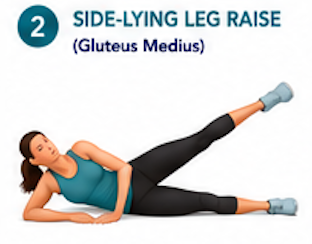
2. Side-Lying Leg Raises (Targets Gluteus Medius)
Lie on one side with your hips stacked.
Keeping the top leg straight and slightly behind your body, lift it toward the ceiling without rolling your hips backward.
Move slowly and with control.
Try: 2–3 sets of 12–15 repetitions on each side.
3. Single-Leg Sit-to-Stand or Step-Down (Functional Glute Strength)
Stand in front of a sturdy chair or on a small step.
Slowly lower yourself while keeping your knee aligned over your second toe. Avoid letting the knee collapse inward.
Return to standing using the same leg.
Try: 2–3 sets of 8–10 repetitions on each side.
This exercise challenges both the gluteus maximus and gluteus medius while mimicking the demands of walking, running, and sports.

A Pediatric Physical Therapist’s Perspective
In my clinic, I rarely look only at the area that hurts. A child with knee pain often has weak hips. A teen with recurrent ankle sprains may have poor pelvic stability. Even athletes recovering from an ACL injury frequently need to rebuild glute strength before returning safely to sport.
Strong gluteal muscles create a stable base for movement. They help children run with better mechanics, jump with more power, land more safely, and reduce unnecessary stress on growing joints.
Whether your child is an elite athlete or simply enjoys playing outside, healthy glute muscles support better movement throughout every stage of development.
Sometimes the strongest muscles in the body are also the most overlooked—and giving them the attention they deserve can make a lasting difference in both performance and lifelong joint health.


