Exercise: The Why, What, and How
Updated: Dec 20, 2025
Key Takeaways
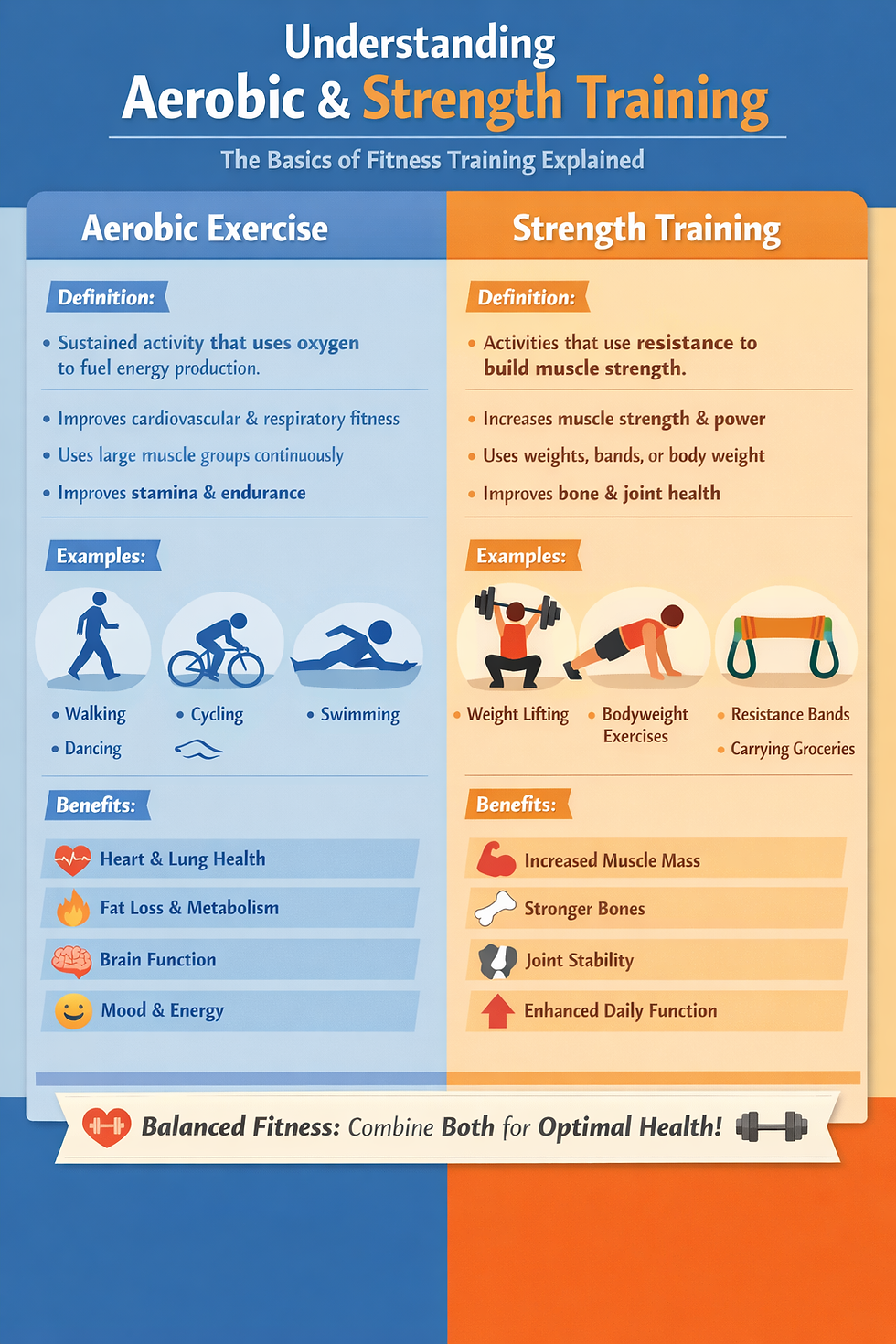
Aerobic exercise improves cardiovascular & respiratory fitness as well as metabolic, immune, cognitive, and mental health.
Strength training exercise improves bone & joint health in addition to benefits of aerobic exercise.
Aerobic exercise should be done at least 150 minutes per week at moderate intensity. Strength training should be done at least 2 days per week with 8-10 exercises per session.
The Why
Aerobic exercise has the following benefits immediately after a session:
Improved Cardiovascular (Heart) Function:
Increased cardiac output and stroke volume
Improved endothelial function and vasodilation (↑ nitric oxide)
Post-exercise hypotension: lowered blood pressure for up to 24 hours
Enhanced blood flow to brain, muscles, and vital organs
Improved Metabolic (Digestion & Sugar Management) Function:
Increased glucose uptake by skeletal muscle (insulin-independent)
Improved insulin sensitivity for 24–48 hours
Increased fat oxidation during recovery
Elevated metabolic rate (EPOC) for several hours
Improved appetite hormone signaling (leptin/ghrelin balance)
Improved Cognitive (Brain) Function:
Increased cerebral blood flow and oxygenation
Elevated brain-derived neurotrophic factor (BDNF)
Improved attention, reaction time, and executive function
Enhanced learning readiness and memory encoding
Improved Mental & Emotional Health:
Release of endorphins and endocannabinoids
Release of dopamine, serotonin, and norepinephrine
Reduced anxiety and stress perception
Improved mood and emotional regulation
Decreased sympathetic nervous system activity post-exercise
Improved Immune (Fighting Colds/Flus/Viruses) Function:
Transient boost in immune surveillance (↑ NK cell activity)
Acute anti-inflammatory response (↑ IL-10, ↓ TNF-α signaling)
Improved regulation of immune cell trafficking
Increased catecholamines during exercise → improved alertness
Improved cortisol regulation post-exercise
Improved Musculoskeletal (Muscle, Bones, Joints) Function:
Increased joint lubrication and synovial fluid circulation
Improved muscle extensibility and temporary flexibility gains
Enhanced nutrient delivery to cartilage and connective tissue
Improved Respiratory (Lung) Function:
Increased ventilation efficiency
Improved oxygen diffusion and utilization
Improved Sleep:
Improved sleep onset latency
Increased slow-wave (deep) sleep later that night
Improved circadian rhythm signaling
Increased parasympathetic (vagal) tone post-exercise
Reduced resting heart rate over the following hours
Additional long-term benefits of aerobic exercise, when done regularly, include:
Improved Cardiovascular (Heart) Function:
Lowered resting blood pressure
Improved cholesterol profile (↑ HDL, ↓ LDL and triglycerides)
Enhanced endothelial function and arterial elasticity
Reduced risk of coronary artery disease, stroke, and heart failure
Improved cardiac output and heart efficiency
Improved Metabolic (Digestion & Sugar Management) Function:
Improved insulin sensitivity and glucose regulation
Reduced risk of type 2 diabetes and metabolic syndrome
Healthier body composition and fat loss
Enhanced mitochondrial density and metabolic efficiency
Improved Cognitive (Brain) Function:
Increased cerebral blood flow and oxygen delivery
Stimulated neurogenesis and synaptic plasticity (↑ BDNF)
Improved memory, attention, and executive function
Reduced risk of cognitive decline, dementia, and Alzheimer’s disease
Improved Mental & Emotional Health:
Reduced symptoms of depression and anxiety
Better stress resilience and emotional regulation
Improved overall mood and sense of well-being
Improved Immune (Fighting Colds/Flus/Viruses) Function:
Reduced chronic low-grade inflammation (↓ CRP, IL-6, TNF-α)
Enhanced immune surveillance and regulation
Lowered risk of certain infections and inflammation-related diseases
Improved Musculoskeletal (Muscle, Bones, Joints) Function:
Improved bone mineral density (especially with weight-bearing activity)
Preserved muscle mass and strength with aging
Enhanced joint nutrition, cartilage health, and mobility
Improved Respiratory (Lung) Function:
Increased lung ventilation efficiency
Improved oxygen uptake and utilization (↑ VO₂max)
Reduced dyspnea (difficulty breathing) during daily activities
Improved Sleep:
Enhanced sleep quality and circadian rhythm stability
Reduced Chronic Disease Risk:
Lowered risk of several cancers (colon, breast, endometrial)
Reduced risk of hypertension, osteoporosis, and frailty
Improved outcomes and quality of life in many chronic diseases
Reduced all-cause mortality risk
Improved Aging:
Improved mitochondrial biogenesis and function
Enhanced antioxidant defense systems
Improved DNA repair and cellular resilience
Slowed biological aging markers
Extended healthspan (years lived without disability)
Strength training has the following benefits immediately after a session:
Improved Cardiovascular (Heart) Function:
Temporary increase in cardiac output during exercise
Post-exercise blood pressure reduction in the hours following
Improved vascular responsiveness
Improved Metabolic (Digestion & Sugar Management) Function:
Increased glucose uptake by muscle (insulin-independent)
Improved insulin sensitivity for 24–48 hours
Elevated metabolic rate (EPOC) for several hours
Increased fat oxidation during recovery
Improved Cognitive (Brain) Function:
Increased central nervous system arousal and focus
Improved executive function and reaction time post-session
Enhanced motor learning consolidation
Improved Mental & Emotional Health:
Increased endorphins and dopamine
Reduced stress and anxiety
Improved mood, confidence, and sense of accomplishment
Improved Immune (Fighting Colds/Flus/Viruses) Function:
Acute anti-inflammatory signaling
Transient increase in immune cell activity
Initiation of tissue repair processes
Improved Musculoskeletal (Muscle, Bones, Joints) Function:
Increased muscle blood flow and nutrient delivery
Increased motor unit recruitment and firing rate
Enhanced neuromuscular coordination and muscle activation
Improved force production and movement efficiency (post-activation potentiation)
Initiation of muscle protein synthesis (peaks ~24–48 hrs)
Cellular swelling (“muscle pump”) supporting anabolic signaling
Acute stimulation of tendon and connective tissue remodeling
Increased satellite cell signaling for muscle repair and adaptation
Mechanical loading stimulates osteoblast activity (building stronger bones)
Increased joint lubrication and synovial fluid circulation
Improved joint stability through muscular activation
Improved Sleep:
Improved sleep quality later that night
Increased slow-wave (deep) sleep, supporting recovery
Additional long-term benefits of strength training, when done regularly, include:
Improved Cardiovascular (Heart) Function:
Lowered resting blood pressure
Improved Metabolic (Digestion & Sugar Management) Function:
Improved insulin sensitivity and glucose control
Increased resting metabolic rate via greater lean mass
Improved body composition (↓ fat mass, ↑ lean mass)
Reduced risk of type 2 diabetes and metabolic syndrome
Improved lipid profile (↓ triglycerides, ↑ HDL)
Reduced visceral adiposity
Improved Cognitive (Brain) Function:
Improved executive function and working memory
Improved Mental & Emotional Health:
Reduced symptoms of depression and anxiety
Improved self-esteem, confidence, and body image
Enhanced stress resilience
Improved Musculoskeletal (Muscle, Bones, Joints) Function:
Increased and preserved muscle mass (prevents sarcopenia- muscle loss with aging)
Improved muscle strength and power
Increased bone mineral density (reduces osteoporosis and fracture risk)
Enhanced tendon and ligament stiffness and resilience
Improved joint stability and alignment
Reduced risk of musculoskeletal injury
Improved neuromuscular coordination and motor unit recruitment
Enhanced balance, proprioception, and reaction time
Reduced fall risk, especially in older adults
Improved functional capacity for daily activities
Increased satellite cell activity and muscle repair capacity
Improved mitochondrial function within muscle fibers
Reduced Chronic Disease Risk:
Reduced risk of frailty and disability
Improved outcomes in arthritis, back pain, and osteoarthritis
Reduced cancer-related fatigue and improves survivorship outcomes
Improved quality of life in many chronic conditions
Improved Aging:
Preserved independence and mobility with aging
Extended healthspan (years lived with strength, not just years lived)
The What
Aerobic exercise is any physical activity that uses large muscle groups, can be sustained continuously, and relies primarily on oxygen-dependent (aerobic) energy pathways to meet the body’s energy demands.
It includes these types of activities
1. Walking (leisurely or brisk)
2. Gardening or yard work
3. Housework (vacuuming, mopping, cleaning)
4. Cycling (outdoor or stationary)
5. Swimming
6. Jogging or running
7. Hiking
8. Dancing (social dancing, Zumba, aerobics classes)
9. Elliptical trainer
10. Rowing (machine or on water)
11. Water aerobics
12. Playing with children (active play, tag, playground games)
13. Climbing stairs
14. Cross-country skiing
15. Jumping rope
16. Skating (ice or roller skating)
17. Tennis (singles or doubles)
18. Basketball (recreational play)
19. Soccer (recreational play)
20. Yoga flow or Pilates (continuous, movement-based styles)
Strength training exercise is any physical activity in which muscles work against an external resistance to produce force, with the goal of maintaining or increasing muscle strength, power, endurance, or size.
It includes these types of activities
1. Weightlifting (free weights or machines)
2. Bodyweight exercises (push-ups, squats, lunges, planks)
3. Resistance band exercises
4. Yoga (poses that support body weight, e.g., planks, chair pose)
5. Pilates
6. Push-ups against a wall or countertop
7. Pull-ups or assisted pull-ups
8. Climbing stairs while carrying items
9. Carrying groceries or heavy bags
10. Lifting and putting away laundry or boxes
11. Shoveling snow or dirt
12. Digging, raking, or heavy gardening
13. Moving furniture or household items
14. Carrying a child or lifting a stroller
15. Manual labor (construction, landscaping tasks)
16. Rock climbing or bouldering
17. Rowing (machine or on water)
18. Kettlebell training
19. Functional training or circuit training
20. Isometric exercises (wall sits, static holds)
The How
You’ll see the most benefits of aerobic exercise at “moderate intensity” for at least 150 minutes per week (about 5 days per week of 30 minutes per session). Moderate intensity is considered exercise at 65-75% of your maximal heart rate. Unless you have access to a formal VO2max test, the estimate of HRmax=220-age is sufficient. See the table below to estimate your moderate intensity range based on age:
Age | Estimated HRmax | 65% HRmax | 75% HRmax |
15 years | 205bpm | 133bpm | 154bpm |
20 years | 200bpm | 130bpm | 150bpm |
25 years | 195bpm | 126bpm | 146bpm |
To check your heart rate while exercising, wear a heart rate monitor, smart watch, or use a clock. When using a clock, check your pulse at your neck or wrist and count the beats for 6 seconds. Multiply the number of beats during that 6 seconds by 10 to get an estimate of your heart rate in beats per minute.
You’ll see the most benefits of strength training if you train all major muscle groups on 2-3 days per week, 8-10 exercises per session. In general, 2-3 sets of 8-12 repetitions per exercise is sufficient. Having muscle soreness, or DOMS (delayed onset muscle soreness), is expected but if it lasts more than 2 or 3 days, you probably made the session too intense.
Bottom Line
Exercise is one of the single best things you can do for your growth, health, and happiness. Even daily tasks and lighter intensity exercise can add up. Try 10 minutes at a time, and see where it gets you.
If you're having trouble starting an exercise plan due to pain, disability, or another physical barrier, be sure to seek out physical therapy. Your physical therapist can help you find the best way to access these unparalleled benefits of exercise!


