3 Key Leg Stretches
Updated: Dec 12, 2025
Key Takeaways:
Stretch Quadriceps, Calves, and Hamstrings after doing leg workouts.
Hold stretches for 30-60 second each.
Read more to avoid common mistakes in positioning to maximize your stretch.
You just finished your run, soccer practice, or conditioning day. You are tired, but know that stretching immediately after your workout is key for improving flexibility, improving recovery, and preventing injury. Here are the 3 stretches you must do after exercising your legs:

The Quadriceps & Hip Flexor Stretch
The Quadriceps is a group of 4 muscles on the front of your thigh. They control movements at the hip and knee and are frequently used with walking, cycling, squatting, jumping, lunging, and running exercises. The Hip Flexors are the muscles that bring your leg forward when walking and running and bring your leg up when you are cycling. When the Quadriceps and Hip Flexor muscles become tight and unbalanced, athletes may feel pain at their hips and/or knees. This tightness places athletes at risk for IT band ("iliotibial band") pain, poor knee cap tracking, overuse injuries, and poor movement patterns.
To stretch these muscles:
Find a support for balance (wall, friend's shoulder, etc).
Grab your ankle and pull your foot toward your buttocks.
Keep your knees together and your knee pointed straight toward the floor.
Common mistakes include pointing the knee outward and forward, which will not stretch the muscles.
For a deeper stretch, tighten to buttocks (gluteal) muscles.
Hold for 30-60 seconds for each leg.

The "Calf" Stretch
The Gastrocnemius and Soleus muscles make up your "calf." They are used when you point your toes away from you body, such as in ballet, shooting a basketball, jumping, and running. When these muscles become tight and unbalanced, athletes may feel pain at their ankles and the bottom of their feet. This tightness places athletes at risk for Achilles tendinitis, plantar fasciitis, and poor movement patterns.
To stretch these muscles:
Find a support for balance (wall, friend's shoulder, etc).
Step your foot back while keeping your knee straight.
Make sure your toes are pointed straight forward.
A common mistake is pointing the toes out to the side, which won't stretch the muscle.
For a deeper stretch, lunge forward by bending your front leg.
Hold for 30-60 seconds for each leg.
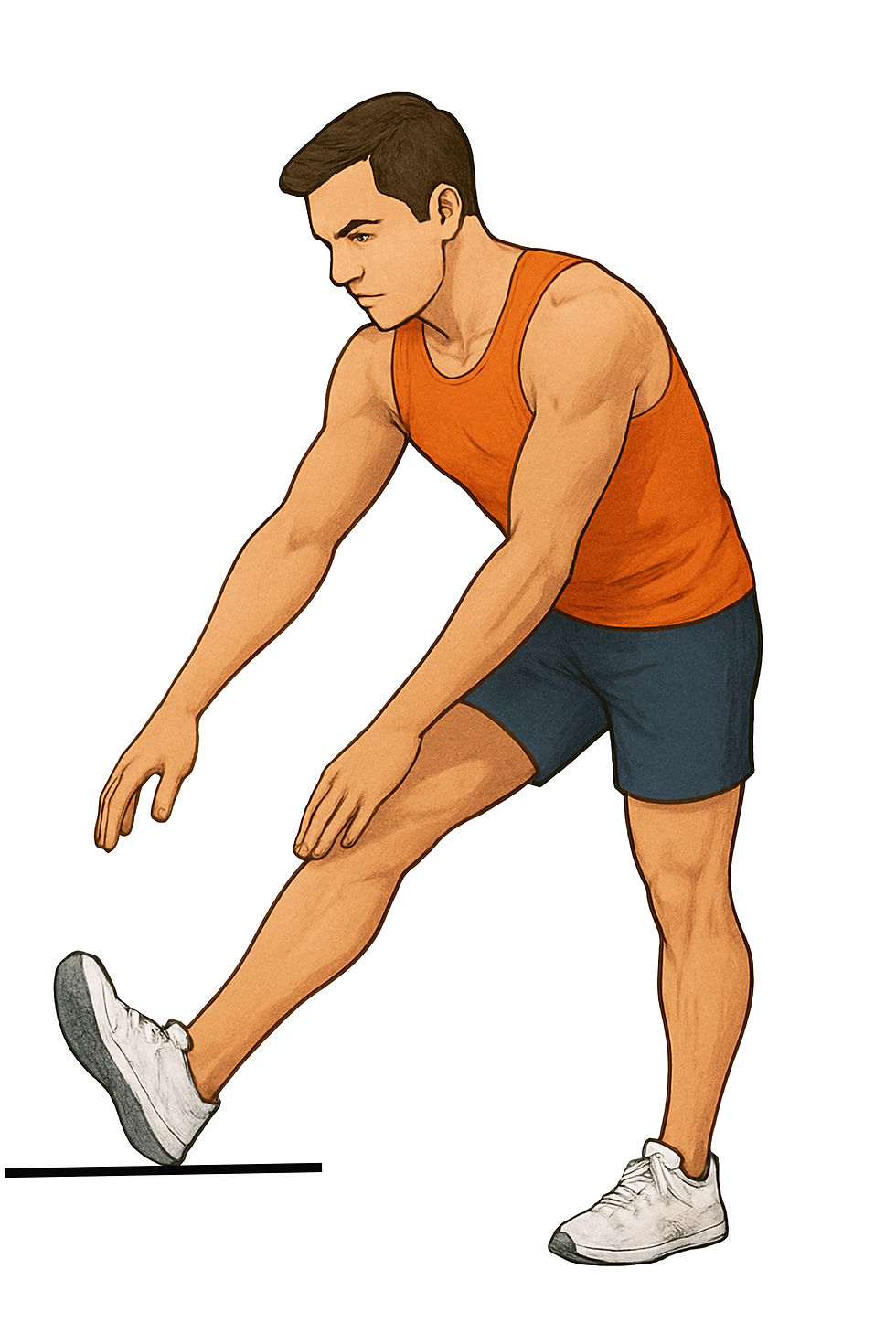
The Hamstring Stretch
The "hamstring" muscles are 3 muscles on the back of your thigh. They control movements at the hip and knee and are frequently used with walking, cycling, squatting, jumping, lunging, and running exercises. When the Hamstring muscles become tight and unbalanced, athletes may feel pain at their hips and/or knees. This tightness places athletes at risk for sciatic nerve pain issues, overuse injuries, and poor movement patterns.
To stretch these muscles:
Find a support for your leg (step, bleachers, etc). If you don't have access to a support, you can rest your foot on the ground.
Reach for your toes while keeping your knee straight.
Make sure your toes are pointed straight up and your back is straight.
Common mistakes include pointing the toes outward, which only stretches some of the muscles, and bending too much in the back, which will not stretch the muscles. Remember, it's not about actually touching the toes but feeling the proper stretch!
Hold for 30-60 seconds for each leg.
Stretching is one of the most important things you can do for your body to enhance your performance, recover better, and prevent injury.
Take 5 minutes after your workout to ensure your gains.


